
Welcome to the Q-Pall Knowledge Base. On this page, you will find a complete overview of frequently asked questions and technical definitions within the pallet industry. Whether you are looking for information on dimensions, material properties, or production techniques: we translate complex logistics terms into clear language, so you can make the right choice with confidence.
Is your specific question or term not listed? Contact us; our experts are happy to look into a solution for your logistics challenge with you.
Our plastic pallets are manufactured from high-quality polymers, specifically a mix of Polypropylene (PP) and Polyethylene (HDPE). As a standard, we utilize recycled materials (such as PE-HD #2), unless safety requirements dictate otherwise.
The exact composition depends on the intended use:
Because our pallets consist of 100% plastic, they are fully recyclable at the end of their service life. This supports a circular process: your old pallet becomes the raw material for a new Q-Pall pallet.

ESD stands for Electrostatic Discharge. This is a physical process where friction causes a static charge to build up, which then suddenly discharges via a spark.
Standard plastic acts as an insulator, allowing static electricity to accumulate through minimal friction. Without the proper measures, this entails two major risks:
To eliminate these risks, we manufacture special ESD-safe pallets. During the production process, we add specific additives to the polymer (HDPE or PP), such as conductive carbon black.
This renders the pallet conductive rather than insulating, allowing static charge to be safely dissipated to the ground. The resistance levels are precisely tuned to your specific safety requirements.
Need advice? Contact us to discuss the specific resistance requirements for your application.
Plastic is naturally an insulator, meaning friction can cause a static charge to build up. While this is less dangerous than an ESD discharge, it is highly undesirable for many logistics processes.
A statically charged pallet acts like a magnet for dirt. This creates two primary problems in the supply chain:
To prevent this, Q-Pall can optionally provide your pallets with synergistic antistatic additives.
These additives are mixed into the plastic during production and ensure that the surface resistance is lowered. As a result, static charge cannot build up, keeping the pallet clean (dust-repellent) and safe to use.
Do you experience dust accumulation or static issues in your warehouse? Contact us to discuss the possibilities for antistatic additives.
Clickable skids are detachable runners specially developed for our Q-Pall Light Series. They transform a lightweight, nestable pallet into a more stable skid pallet, without compromising on operational efficiency.
The unique advantage lies in the savings on transport and storage costs. Because the skids are supplied separately, you benefit from the best of both worlds:
Technical knowledge is not required. The skids are designed in such a way that you can quickly and easily click them under the pallets from the Light Series yourself. This offers maximum flexibility in your logistics process.
Do you want to calculate how much space you can save with this system? Contact us for tailored advice.
The choice depends on your storage system and the vulnerability of your load. These are the three most common variants:
Are you unsure which base structure fits your warehouse system? Contact us; we are happy to advise you on the right configuration.
With this load, the pallet rests solely on the two beams of the rack (beam racking). The pallet effectively “hangs” freely in the center. This demands the utmost from the structural rigidity. Exceeding this weight leads to dangerous deflection or breakage.
The specifications we state are based on a Uniformly Distributed Load (UDL).
During our tests, we load the pallet with 25 kg bags spread over the entire surface. This simulates a realistic practical situation.
Note: In the case of point loading (a heavy weight concentrated in one spot), the load capacity may be lower than the specified racking load; this must be tested in practice.
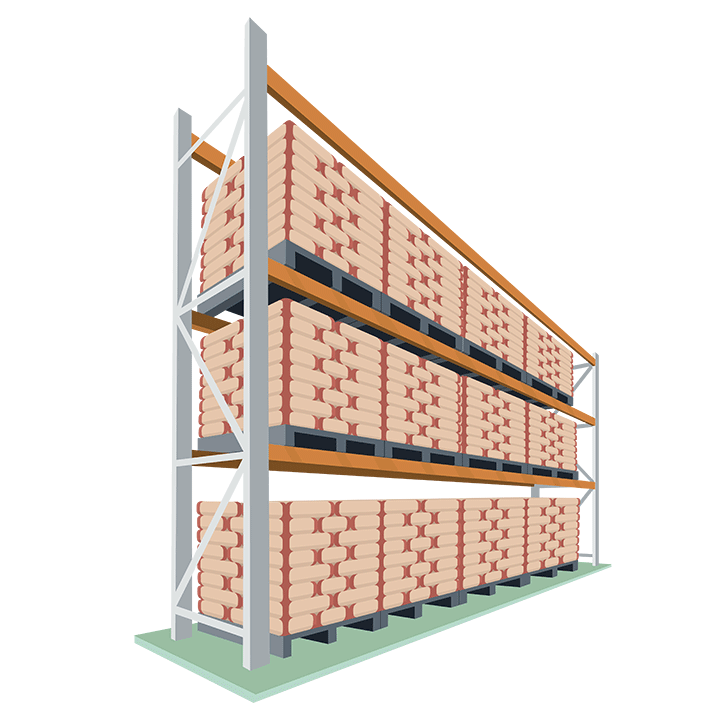
The pallet rests only on the outer beams.
Dynamic Load is the maximum weight a pallet can bear while it is in motion. This is the relevant value for internal transport using a forklift or pallet jack.
When a pallet is moved, additional forces act on the structure. Consider:
Due to these external forces, the dynamic load capacity is always lower than the static load capacity (when the pallet is stationary on the ground).
Just like with racking load, this value only applies with a uniformly distributed load. If the center of gravity of your load is at a single point, the pallet may tip or break, even if the total weight remains below the limit.
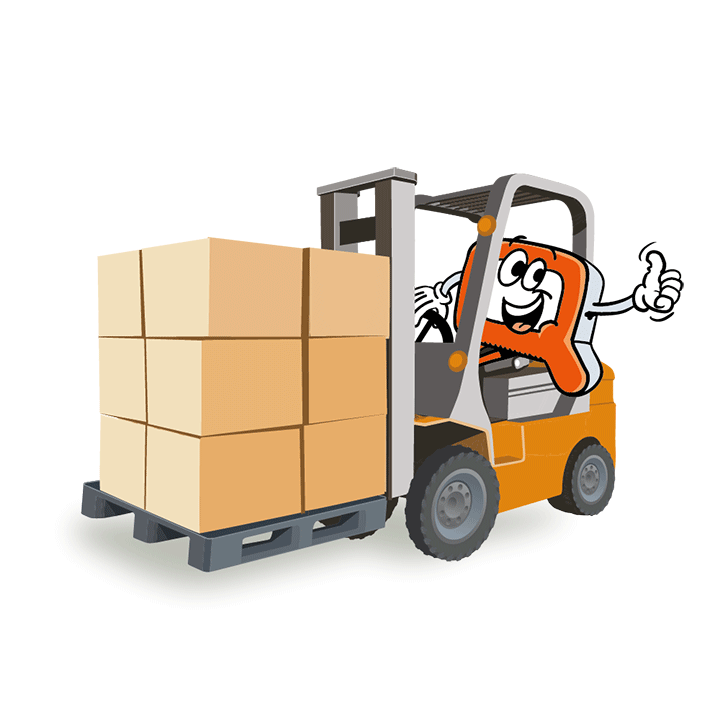
Load during transport and handling.
The static load is the maximum weight a plastic pallet can bear when placed on a flat, stable surface. Because the pallet is fully supported in this case, this figure is almost always higher than the dynamic or racking load.
This value is the leading factor in two specific situations in your warehouse:
If multiple pallets are stacked, the total weight determines the load on the bottom pallet.
Example: You stack 3 pallets of 500 kg each on top of one another. The bottom pallet then bears the weight of the two pallets standing on it (1,000 kg). The static load capacity of the bottom pallet must therefore be at least 1,000 kg.
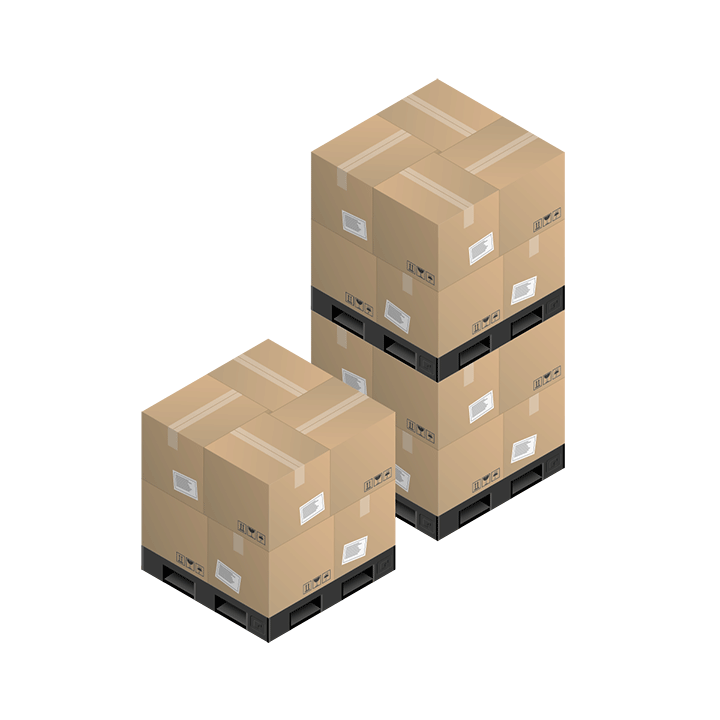
The load capacity indicates the maximum weight a plastic pallet can safely bear. This is the most important specification for your choice, as overloading can lead to damage or unsafe situations.
The construction and the material used determine the strength of the pallet. A smartly designed plastic pallet combines a low tare weight with a high load capacity. However, a pallet with a higher load capacity is not by definition ‘better’; it is about ensuring the specifications match your intended use.
Load capacity is never just one fixed number. In technical specifications, we distinguish between three situations:
Note: The values for these three situations differ significantly per pallet.
Are you unsure which load capacity is required for your logistics process? Contact us; we are happy to help you find the right match between load and pallet type.
The carbon footprint of a plastic pallet expresses the total environmental impact in kilograms of CO2 equivalent (kg CO2 eq.). To make this impact transparent for you, official Environmental Product Declaration (EPD) documents are available for all Q-Pall pallets.
Greenhouse gas emissions occur at various stages of the life cycle. The greatest impact usually arises during:
We minimize these emissions at every step of the process. By making intensive use of recycled plastics and organizing the ‘end-of-life’ process (full recycling of old pallets), we significantly lower the ecological footprint compared to wooden alternatives or virgin plastic.
Do you want to dive deeper into our sustainability strategy? Read all about our vision on recycling and reduction in our Orange Values.
When selecting a plastic pallet, the choice of the top deck is decisive for functionality. You can choose between an open structure (gridded) for weight savings or a closed deck for hygiene and load capacity.
A pallet with an open structure contains holes or grids in the deck.
These pallets have a completely solid surface, often with a smooth finish.
Are you unsure which type of deck best fits your logistics process? Contact us to review the specifications for your application.
Yes, it is possible to fully customize your plastic pallets with your company logo or in your own corporate color. This not only increases brand recognition but also acts as a preventive measure against theft and loss in the supply chain.
To place your logo or ownership mark, we use various techniques, depending on the desired look and durability:
We can produce pallets in almost any desired color. However, the choice of material is decisive here:
Do you want to know the costs for personalizing your batch? Contact us to discuss your wishes and the technical possibilities.
An anti-slip pallet is specially developed for slippery packaging or unstable loads. The increased friction level of the top deck prevents goods from shifting during transport (dynamic load) or empty pallets from sliding away when stacking.
Whereas standard pallets made of PE or PP can sometimes be too smooth, anti-slip pallets use a specific material to guarantee grip: TPE (Thermoplastic Elastomer).
The unique properties of TPE polymers are:
Do you struggle with sliding loads or are you looking for a specific anti-slip solution? Contact us to see which type of pallet best secures your load.
The specifications of pallet dimensions go beyond just length and width. For automated systems and handling equipment, the height, ground clearance, and position of the blocks are crucial.
01 & 02. Length and width: The basic dimensions (e.g., 1200 x 800 mm).
03. Height: Usually varies between 120 and 160 mm. This directly affects the load capacity: the higher the construction, the stronger the pallet often is.
04. Ground clearance: The free space between the top deck and the floor (standard 89, 95, or 100 mm). This is essential for the forks of a pallet jack.
05. Blocks (Support beams): The width of the blocks is critical for conveyor systems. Center blocks often must not be wider than 150 mm.
06. Entry width: The distance between the blocks. This must comply with the ISO 6780 standard to be accessible for all forklifts and pallet jacks.
Do you have specific requirements for your conveyor belts or warehouse cranes? Contact us to verify the exact dimensional tolerances.
The rounded edges of our plastic pallets are a deliberate design feature. Unlike wooden pallets, which often have sharp sawn corners, plastic pallets are designed to minimize damage to your load and equipment.
The rounded finish offers protection on three levels:
Do you want to switch to pallets that cause less damage to your product flow? Contact us for a model that fits your packaging process.
The price of a plastic pallet is not a fixed figure, but a sum of specifications. Although the initial purchase price is often higher than wood, the Total Cost of Ownership (TCO) is frequently lower due to the long lifespan.
The final cost price per pallet is determined by:
Transport is a major cost item and an environmental burden. Q-Pall minimizes this by producing at multiple locations in Europe. We deliver from the factory closest to your delivery address. This results in lower transport costs and significantly reduced CO2 emissions.
Do you want to know exactly where you stand? Request a quote for an accurate price calculation including transport to your region.