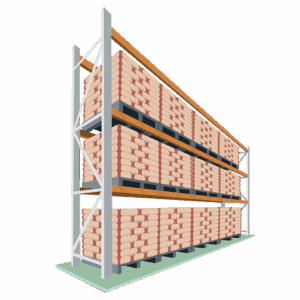
The Euro pallet format is perfectly tailored to European logistics, offering compatibility with trucks, containers, and warehouse racks. Across Europe, there are more than 450 million Euro pallets in circulation, according to EPAL, highlighting the importance of this standardization.
The standard size for European logistics
The dimensions of 1200 x 800 mm are ideally suited to the sizes of European trucks, containers, and warehouse racks, contributing to streamlined logistics. Thanks to this standardization, companies across Europe can easily exchange pallets, transport goods efficiently, and optimize storage space.
Advantages of the standard dimensions:
- Compatible with all European transport systems: Perfectly fits trailers, trucks, and containers.
- Efficient in warehouse racks: Optimized for use in pallet racks and automated storage systems.
- International standard: Widely accepted for import and export within Europe.
Q-Pall’s plastic Euro pallets combine the benefits of this size with the durability and reusability of recycled plastic, available in three variants:
Light variant – lightweight and nestable
The Light plastic pallets 1200 x 800 mm are specifically developed for applications requiring low self-weight and easy handling. These pallets are nestable, meaning they can be stacked inside one another when empty, resulting in significant space savings.
Applications:
- Export applications: Lightweight, ideal for one-time use.
- Light loads: For packaged food, promotional items, or non-food products.
- Space-saving storage: Ideal for businesses with limited storage capacity.
Advantages of the Light variant:
- Lightweight: Lower transport costs and easy to move manually.
- Nestable: Up to 50% space-saving during return transport or storage.
- Sustainable: Made from recycled plastic, fully recyclable.
- Safe: No splinters, nails, or loose parts.
Medium variant – optimal price/quality and light racking use
The Medium plastic pallets 1200 x 800 mm offer the perfect balance between weight, load capacity, and price. This variant is suitable for a wide range of applications, including light racking and medium-weight loads.
Applications:
- Distribution centers: For daily logistics operations.
- Retail: For the transport and storage of bulk goods and promotional items.
- Warehouses with light racking loads: Suitable for medium-weight loads in pallet racks.
Advantages of the Medium variant:
- Stronger than the Light version: Suitable for heavier loads.
- Light racking use: Can handle light to medium loads in racks.
- Good price/quality ratio: Durable and affordable.
- Hygienic: No moisture absorption, easy to clean.
Heavy variant – for intensive use and racking storage
The Heavy plastic pallets 1200 x 800 mm are designed for heavy industrial applications and fully suitable for use in pallet racks. These pallets are extremely robust and built to handle high loads, both static and dynamic.
Applications:
- Industrial sector: Transport of heavy components, machinery, or bulk goods.
- Chemical industry: For transporting barrels, sacks, and heavy loads.
- Racking use: Suitable for heavy storage in pallet racks.
- International transport: For large, heavy export loads.
Advantages of the Heavy variant:
- High load capacity: Suitable for heavy loads up to hundreds of kilograms per pallet.
- Rack-compatible: Safe for use in warehouse racks.
- Extra robust: Designed for long-term, intensive use.
- Sustainable: Long lifespan, fully recyclable.
Applications of plastic Euro pallets 1200 x 800 mm
The versatility of Q-Pall plastic pallets makes them ideal for various sectors, including:
- Retail & Supermarkets: Ideal for bulk products and seasonal promotions.
- Food industry: Hygienic, suitable for packaged food products.
- Pharmaceutical sector: Hygienic and easy to disinfect.
- Distribution centers & Logistics: For various loads, from light to heavy.
- Industrial production: For heavy machinery, components, and bulk packaging.
Why choose Q-Pall plastic pallets 1200 x 800 mm?
Q-Pall’s plastic Euro pallets combine standardization, safety, and sustainability in one product. Whether you choose the Light, Medium, or Heavy variant, you will benefit from:
- Always close by: Produced at one of our locations in Europe, reducing transport and CO2 emissions.
- Sustainability: Made from recycled plastic and fully recyclable.
- Space-saving: Nestable in the Light variant.
- Cost-efficiency: Lower transport costs due to lightweight construction.
- Hygiene: No moisture absorption, easy to clean.
- Safety: No splinters, nails, or loose parts.
- Broad applicability: Suitable for various sectors and purposes.
Choose Q-Pall plastic pallets 1200 x 800 mm for a more efficient, safer, and sustainable logistics solution.